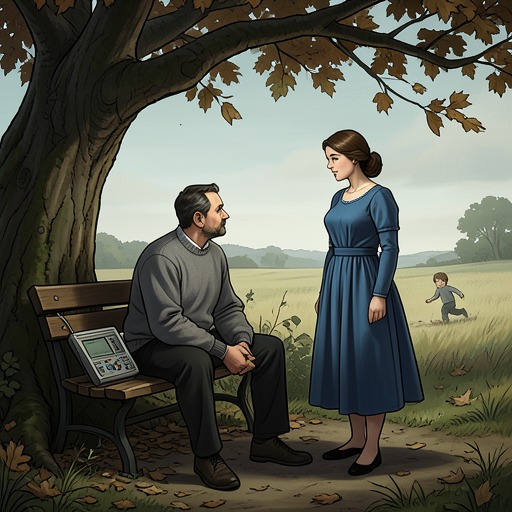
Clarendon, Texas
The Journey CollectionClarendon, Texas, functions as far more than a place of origin. It is the physical setting through which Travis McCoy measures the distance between the boy he once was and the man he becomes. Its football field, school gymnasium, familiar streets, local businesses, and tightly connected community preserve the past while making room for Travis’s return. By the end of the story, Clarendon has changed from the town Travis believed he had to escape into the home he understands he can finally inhabit.
Definition and Setting
Clarendon, Texas, is presented as a small hometown whose public life revolves around the local school and the Clarendon High School Broncos. Travis’s connection to the town begins in childhood, when his father, Russ McCoy, drives him to Austin, Texas, to watch the Broncos win the state championship for the first time in school history. Travis does not yet understand football’s rules or fundamentals, but the stadium spectacle—the players meeting at the forty-yard line, the collision of helmets, and the crowd’s response to the winning touchdown—makes the game his first great ambition. Clarendon therefore enters the narrative through memory as the source of both Travis’s football identity and his lifelong desire to stand on the field himself.
The town’s physical appearance seems largely unchanged when Travis returns years later. A new convenience store has replaced two failed gas stations, Clayton’s Groceries has received fresh red paint and a new sign, and the bank, insurance offices, and pharmacy still line the familiar route. Each business displays support for the local football team. The modest alterations suggest time passing without erasing the town’s essential identity, while Travis’s reaction—recognizing that “not a damn thing had changed”—reveals how strongly Clarendon remains fixed in his imagination.
Football and Public Community
The school gymnasium and football field are Clarendon’s principal communal stages. When Travis parks outside the gymnasium, he hears the band playing the fight song and the noise of students, fans, and parents gathered for the pep rally. The packed bleachers, spectators standing along the walls, maroon, white, and silver pompoms, players in maroon jerseys, and handmade posters turn the building into a public expression of collective allegiance. The homecoming queen presentation further shows that school ritual in Clarendon joins athletics, civic identity, and social ceremony in one shared space.
The football field carries a more personal charge for Travis. After a bitter confrontation with Russ, Travis returns to the lot between the school and the field to calm himself before speaking to the team. He is angry enough to imagine drinking alone on a country road, but his promise to address the players keeps him connected to the community. Later, he leads the team through the inflatable tunnel while the band plays, reaches the fifty-yard line, and discovers that the experience of standing before Clarendon’s crowd surpasses even the largest professional stadiums he has known. The difference is not the size of the audience but the feeling of being held by the town’s affection.
Before the game, Travis tells the players to value every moment on the field and to give themselves fully to the sport. He then joins them in the Lord’s Prayer, with the boys kneeling beside him before entering the stadium. The prayer makes the team’s entrance both athletic and communal, placing competition within a moral framework of discipline, belonging, and shared responsibility. Once on the field, Travis tells the players that the crowd’s cheers have been earned through their hard work and that the community is proud of the men they are becoming. In Clarendon, victory is therefore measured not only by the scoreboard but also by whether the players honor the faith placed in them.
Return, Conflict, and Reconciliation
Clarendon is the place to which Travis returns after receiving a homecoming invitation, initially expecting difficult questions about his future and maturity. Instead, the journey exposes the emotional life he had abandoned. Coming home gives him a second chance to heal his broken heart, reconnect with Russ, and discover Max, the son whose existence he had not previously known. Travis’s return also brings him back into Penelope Stone’s life, forcing him to confront the relationship he had left behind when he departed town.
His first day back is marked by conflict rather than immediate comfort. Travis accuses Russ of failing both Loralie McCoy and himself, and Russ admits that he was not the husband or father he should have been. Travis leaves the house rather than continue the argument, but the withdrawal does not restore his old distance. Clarendon repeatedly places him in situations where private pain becomes visible within familiar public spaces: the school, the field, the local restaurants, and the homes of the people who remember him. The town’s closeness makes avoidance difficult, but that same closeness supplies witnesses and support for reconciliation.
The community’s welcome gradually changes Travis’s understanding of home. During homecoming, people approach him to shake his hand and tell him how much the boys admire him. Travis thanks them and insists that the players have inspired him instead. Cal Hendricks’s earlier assurance that Travis is always welcome in Clarendon finally proves true. The welcome is not merely nostalgic; it gives Travis permission to belong again. He recognizes that he can return not as the celebrated athlete he once was, but as a man willing to accept responsibility for Penelope, Max, Russ, and the community that shaped him.
Family Rituals and New Membership
Clarendon becomes the setting in which Travis’s private commitments acquire public and legal form. He asks Penelope to marry him by recalling that he has loved her since he was fourteen and that she has always owned his heart and soul. The proposal transforms the place associated with their separation into a site of permanent choice. Travis then asks to change Max’s last name to McCoy, explaining that if Penelope is going to be a McCoy, he wants Max to be one as well. The request makes fatherhood a deliberate act of recognition rather than an accidental biological fact.
The wedding completes that movement from private desire to publicly witnessed family. During the ceremony, Travis and Penelope exchange vows and rings, then invite Max to stand between them as the three of them light the eternity candle together. The ritual makes the child part of the marriage’s visible structure and presents the family as a unit before the gathered community. Clarendon’s religious and social institutions thus do not merely observe the family’s formation; they help confirm it.
The town also witnesses the family’s later expansion. When Nadine opens a box containing an ultrasound photograph, Russ recognizes the news that Penelope is pregnant and reacts with startled emotion, even threatening humorously to punish the adults if the announcement is a joke. The scene places new life within the same network of grandparents, parents, and children that has been repaired through Travis’s return. Clarendon’s domestic gatherings turn family news into shared communal knowledge.
Continuity and Significance
Clarendon’s significance lies in its ability to hold contradiction. It preserves the football culture that first drew Travis away, yet it ultimately teaches him that professional achievement is not the only measure of a meaningful life. It contains painful memories of parental failure and romantic abandonment, but it also provides the spaces in which those injuries can be acknowledged and repaired. The unchanged streets and renovated storefronts mirror Travis’s own experience: the underlying emotional structure remains, while the people who inhabit it have changed.
The town’s football tradition also passes into the next generation through Travis’s coaching. Addressing thirty-two players—the largest turnout in three years, including Max—he demands “Time, passion, heart, and soul” and tells them that the community’s expectations rest on their shoulders. He promises that winning will depend less on the scoreboard or the win-loss record than on how much of themselves they give to the game. This doctrine revises the childhood dream that began with the Broncos’ championship. Football remains central to Clarendon, but under Travis’s leadership it becomes a language of commitment, mentorship, and family responsibility rather than an escape from home.
Clarendon, Texas, finally represents the possibility that return can be an act of transformation. Travis once believed that leaving town cost him everything; after coming back, he understands that the departure also concealed the relationships he needed to recover. The town receives him through its fields, rituals, memories, and people, then allows him to leave and return in a new role—as Penelope’s husband, Max’s father, a reconciled son, and a coach responsible for the next generation. Its decisive narrative function is to make home not a fixed refuge from change, but the place where change becomes lasting.